
Effect of feeding Bacillus subtilis and Saccharomyces cerevisiae-fermented sunflower oilcake on growth performance, immune response, and intestinal microbiota in Pacific white shrimp
Published:
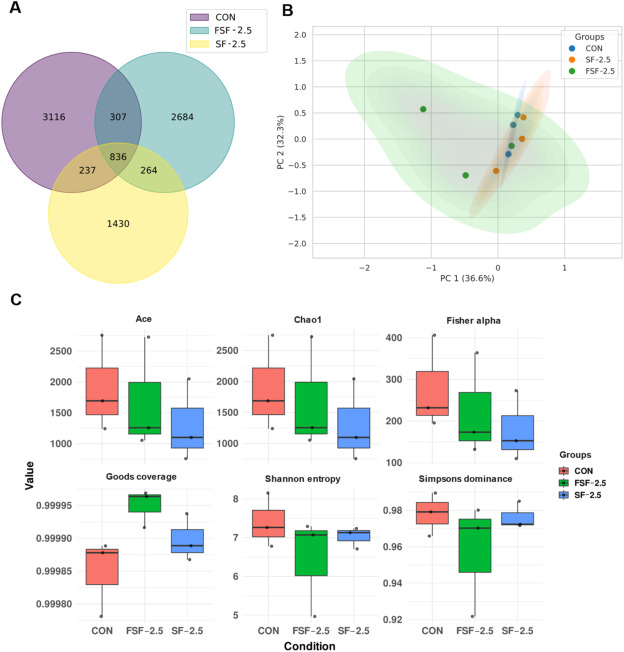
Abstract Sunflower oilcake (SF) has limited use in aquafeeds due to its high fibre content and anti-nutritional factors (ANF). Microbial solid-state fermentation (SSF) can mitigate these limitations while enhancing nutritional and functional value. This study evaluated the potential of microbial fermented sunflower oilcake (FSF) in diets for Pacific white shrimp (Penaeus vannamei). Commercial SF was fermented using Bacillus subtilis (1 × 10⁹ CFU/mL) and Saccharomyces cerevisiae (1 × 10⁸ CFU/mL) at 34 °C in a pilot-scale fermenter. A total of 180 iuvenile shrimp (1.86 ± 0.01 g) were fed three isonitrogenous diets: a control diet (CON), a diet with 2.5% raw sunflower oilcake (SF-2.5), and a diet with 2.5% fermented sunflower oilcake (FSF-2.5) for 56 d. Feed analysis indicated that fermentation increased crude protein and essential amino acid contents, while reducing fibre and ANF such as tannins and saponins. Shrimp fed the FSF-2.5 diet showed significantly higher weight gain and daily growth coefficient (DGC), and a lower feed conversion ratio (FCR) compared with other dietary groups (P < 0.05). Protease and amylase activities were significantly higher in the FSF-2.5 group, followed by CON and SF-2.5 (P < 0.05). Superoxide dismutase (SOD) and phenoloxidase (PO) activities were also significantly higher in shrimp fed the FSF-2.5 diet (P < 0.05). Histological examination revealed that the FSF-2.5 group exhibited normal hepatopancreatic architecture with intact tubules and an adequate presence of blister-like, fibrillar, and resorptive cells. Gut microbiota analysis using 16 S rRNA sequencing revealed that shrimp fed the CON diet had the highest number of unique amplicon sequence variants (ASV; 3116), followed by FSF-2.5 (2684) and SF-2.5 (1430). The FSF-2.5 diet increased the relative abundance of potential beneficial bacterial groups, such as Fulvivirga, Ruegeria, and Shimia, while reducing the pathogenic Pseudomonas in the shrimp gut (P < 0.05). Differential abundance analysis of ASV using analysis of compositions of microbiomes with bias correction (ANCOM-BC) from QIIME2 plugin revealed enrichment of beneficial Micrococcus and Staphylococcus in the FSF-2.5 group compared with SF-2.5. These findings demonstrate that FSF functions beyond its nutritional role, acting as a gut health promoter, and can be considered as a sustainable functional feed ingredient for shrimp aquaculture.