
SOCIAL SCIENCE DIVISION
SOCIAL SCIENCE DIVISION
PROFILE
The Social Sciences Division (SSD) in ICAR-Central Institute of Brackishwater Aquaculture was formed in 1992. It is the gateway of CIBA and the linkage-pin between the institute and the stakeholders and other institutions as a whole. SSD is a composite division having scientific expertise in aquaculture extension, aquaculture economics and computer applications in aquaculture, which gives a cutting edge to the Division. SSD has both research and capacity development programmes. The SSD scientists have been undertaking studies on a diverse set of socio economic issues affecting the sector, which broadly include pragmatic extension approaches for aquaculture sustainability, livelihood development models, entrepreneurship development, gender mainstreaming, evaluation and impact studies, creation of database in brackishwater aquaculture and application of Information and Communication Technology for rapid communication of technology advisories to the stakeholders. Further, with a multi-disciplinary expertise the faculty is also experienced in conducting the socio-economic evaluation of technologies focusing on Doubling of Farmers Income and partnering with the scientists of technology development divisions to refine their innovations. The scientists are recognised as research supervisors for guiding Ph.D students under the University of Madras providing an opportunity for intensive academic learning.
Thrust areas of Research
Aquaculture Economics
- Business cycle forecast in brackishwater aquaculture with a focus on shrimp farming
- Crop insurance requirements for price production and disaster insulation for small farmers
- Economic loss assessment in shrimp farming industry
- Development of Impact assessment tools for aquaculture sector
- Market and price analyses of aquaculture products
- Risk management analysis in brackishwater aquaculture
- Studies on brackishwater based farming systems in India
Aquaculture Extension & Information and Communication Technology
- Smart shrimp aquaculture: Application of ICT and real-time data analytics for input optimization and sustainability.
- Frontline Extension Programmes for technology assessment and refinement
- Dissemination of brackishwater aquaculture technologies through multiple platforms.
- Development of mobile applications for Seabass culture and farm management
- Farmer to Farmer Extension through Networking
- Assessment of skill gaps for capacity enhancement
- Brackishwater aquaculture based livelihood security models for coastal fisher families.
- Development of multi-criteria based decision making tool for aquaculture development of estuaries.
- Application of robotics and drone based monitoring system shrimp aquaculture.
- Brackishwater Aquaculture database management
Ongoing research projects
- In-house Research Project
- Special Programmes
- Tribal Sub-Plan
- SC- Sub Plan
- Externally Funded Projects
- Cage Aquaculture in the brackishwaters of Puducherry and Karaikal regions of Puducherry Union Territory - A feasibility study Funded by the Government of Puducherry under the world bank funded FIMSUL programme.
- Development and validation of Smart Aquaculture Model (SAM): Application of ICT and data analytics for sustainable shrimp aquaculture – Funded under NASF of ICAR, New Delhi
- Knowledge and Economic Empowerment of Women, Tribal and their families in coastal villages of Tamil Nadu through adoption of brackishwater aquaculture and allied technologies integrated with societal development programmes – Funded by Chennai Petrochemical Corporation (CPCL), Chennai
- Sustainable livelihood models for resource poor fish farmers / fisher folk in Nagappatinam district of Tamil Nadu for doubling their income – Funded by Chennai Petrochemical Corporation (CPCL), Chennai.
PUBLICATIONS
- Peer Reviewed Journals
- Papers Presented in Conferences/ Seminars / Symposium / Workshops etc.
- Books and book chapters
- Technical Bulletins / Pamphlets
- Popular Articles
SCIENTISTS

Dr.C.V. Sairam, Principal Scientist & SIC
Email: CV.Sairam@icar.org.in
Phone:+91- 044 - 24618817, Ext-120
Dr.T.Ravisankar, Principal Scientist
Dr. Ms. B.Shanthi, Principal Scientist
Dr. Ms. D.Deboral Vimala, Principal Scientist
Dr.M.Kumaran, Principal Scientist
Dr. Ms. P.Mahalakshmi, Principal Scientist & OIC Engg. Cell and AKM Unit
Dr. R. Geetha, Senior Scientist
SUPPORTING STAFF
SALIENT ACHIEVEMENTS
Aquaculture Economics
1.Aquastat 2019
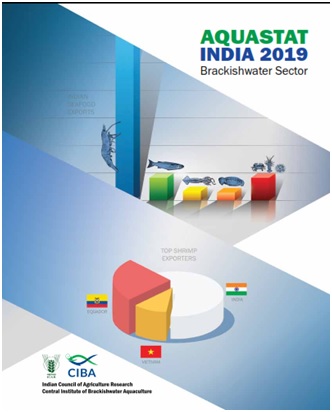
Aquastat India 2019 is the comprehensive database on world and Indian scenario of brackish water aquaculture consists of resources, production and trade statistics from 1991 to 2018. This compendium has been brought out with information in brief about the various technical aspects of the brackish water aquaculture sector. Online Aquastat work is being carried out and will be launched shortly.
2.Economic benefit of Penaeus vannamei
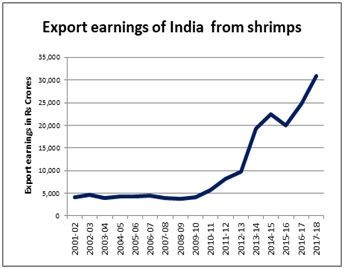
SPF-Penaeus vannamei V is a high value export item. Out of 7 billion USD worth seafood exports during the financial year 2017-18, frozen shrimp contributed 5 billion USD, which consists mainly of SPF-PV. India was the lead exporter of the global shrimp market with 36% market share (FAO, 2019). The total economic surplus generated by SPF-PV is estimated at Rs.3, 96,156 crores during the 9 years (2009-10 to 2017-18). Reduced diseases under bio secure conditions have made per ha productivity to 6.42 t/ha in the triennium ending 2018 compared to 1.4 t/ha of pre vannamei scenario (before 2009).
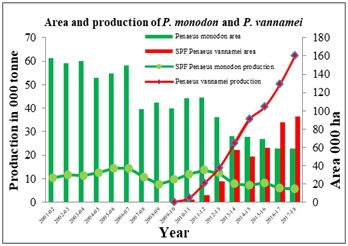
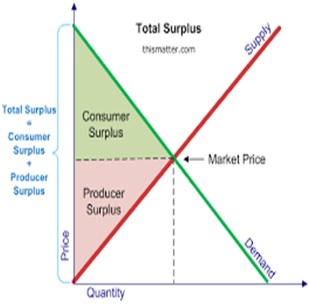
The Internal rate of Returns is estimated at 51%. The estimated ratio between consumers and producers surplus is 66%:33%.. Economic surplus includes Producer Surplus and Consumer Surplus. By higher Production / Profit, Producers become well off. For that scientific technology plays a crucial role. Partial Contributions of the increase in production leads to reduced price for the consumers leaving them a large surplus. P vannamei production has benefitted both the Producers and the Consumers.
- Impact of Vannamei Plus
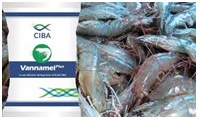
ICAR-CIBA MoUs >15 feed mill companies for transfer of indigenous feed technology using locally available raw materials. Currently about 7 feed mills are in commercial production supplying about 1,00,000 tonnes of feed serving an area of 7015 ha. The CIBA feed technology has contributed a national production of 65600 tonnes (about 10% of national production in 2018) with a value of Rs. 3152 Crores in 2019. It has also produced 1,25,000 man-days. It has also saved Rs.20 lakhs in way of cost of farm inputs
- Trend in shrimp export performance
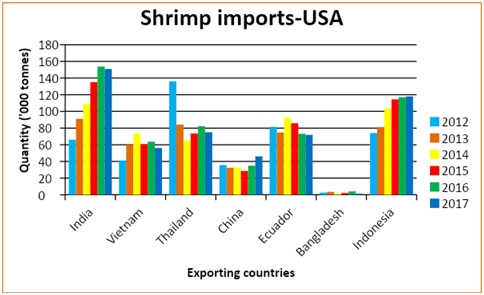
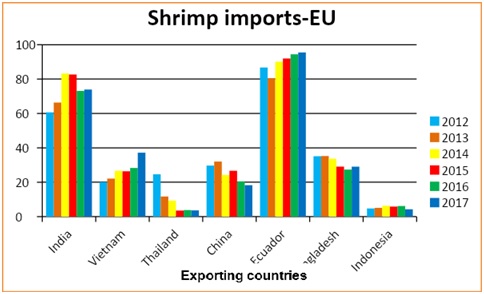
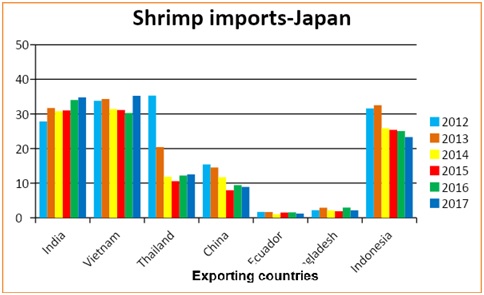
India exported annually more than 130,000 t of shrimp, and became the major supplier to the USA market followed by Indonesia (100,000 t). Share of shrimp exports to EU member states by India, Ecuador Bangladesh, and Indonesia maintained, while that of China and Thailand declined marginally in the last six years. Indian shrimp exports showed a increase until 2015 (82,700 t) and managed to retain its share in subsequent years. Indian shrimp exports to Japan maintained around 35,000 t with a transient decline during 2008-09. Indonesia, leader of shrimp exporting country for Japan in 2002 has reduced less than half reaching 23,312 t in 2017 and Vietnam and China also showed a similar trend.
Aquaculture Extension
- Three-tier system of cage aquaculture in open brackishwaters for livelihood security and doubling the income of coastal fishers
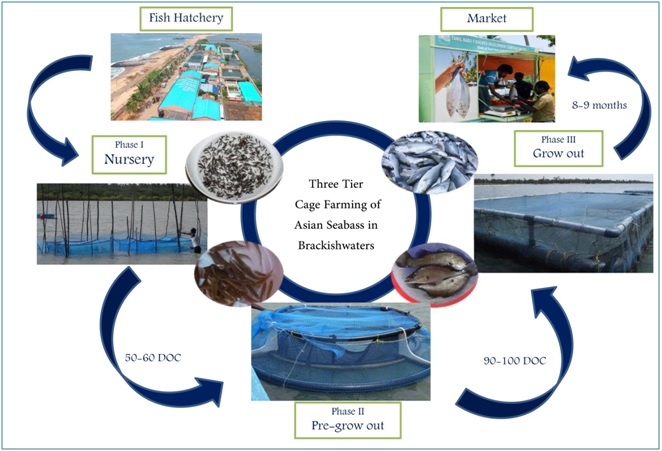
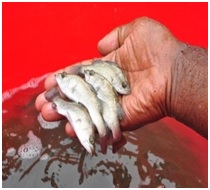
The open brackishwater resources could be efficiently utilized for fish production by developing location specific cage culture systems. The ICAR-Central Institute of Brackishwater Aquaculture, Chennai has validated a three-tier model of cage farming comprises of nursery, pre-grow-out and grow-out cycles suitable for brackishwater bodies with the participation of coastal fishers at Edaikazhinadu village cluster, in Kancheepuram district, Tamil Nadu. Hatchery produced Seabass (Lates calcarifer) fish fry of 2 cm size were stocked in small net cages grown to an average size of 7.3 cm with a mean survival of 40% in 50-60 days. Subsequently the fingerlings were reared in pre-grow out cages for 90-100 days later the juvenile fishes of 100-125 g size were transferred to grow out cages. The survival in pre-grow out phases were 80-90%. The fishes were fed with CIBA SeebassPlus feed at the rate of 8-10%, 4-6% and 2-4% of body weight respectively in nursery, pre-grow out and grow out phases. In 270 days of grow-out culture, the fishes attained a marketable size of 900g to 1.2 kg. The fishers were linked with Tamil Nadu Fisheries Development Corporation, a government owned agency for procurement and marketing of quality fishes to consumers. Seabass fishes of 1kg size were sold @ Rs.380 at the cage site itself and quality of the cage reared fishes was premium. The economics worked out indicated that a benefit cost ratio of 1.6,1.4 and 2.3 respectively for nursery rearing, pre-grow out and grow-out phases. Cage farming provided them livelihood security and an additional monthly income of Rs.8000, Rs.4900 and Rs.8500 per head respectively in nursery rearing, pre-grow out and grow out farming for spending just two hours per day. The findings proved that three-tier cage farming in brackishwaters is economically viable model, which provided livelihood security and doubling the income of coastal fishers. Therefore, appropriate policy guidelines for optimal utilization of open brackishwaters involving coastal fishers and a promotional scheme with inbuilt subsidy for crafting cage infrastructure and critical inputs are the need of the hour to scale-up this win-win approach.
2. Brackishwater Farmers Conclave - 2020
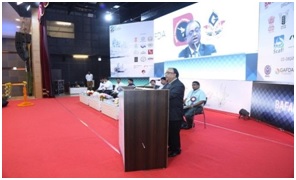
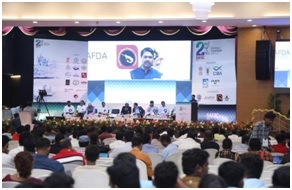
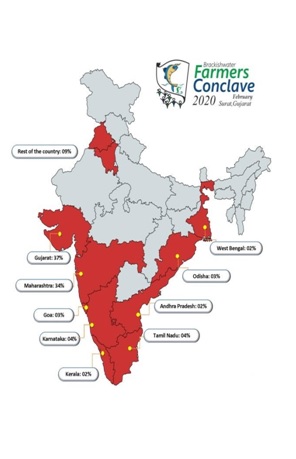
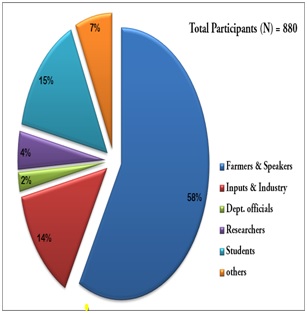
ICAR-Central Institute of Brackishwater Aquaculture (ICAR-CIBA), in collaboration with Society of Coastal Aquaculture and Fisheries (SCAFi) and Navsari Agricultural University (NAU), Gujarat successfully conducted the Brackishwater Aquaculture Farmers Conclave -2020 (BAFAC-2020) the first of its kind in the West Coast of India during 19th and 20th Feb, 2020 at Surat, Gujarat. About 900 brackishwater farmers representing all the coastal states covering both East and West Coasts of India, from West Bengal to Gujarat and inland states like Haryana Punjab and Rajasthan attended the programme, whereas aqua farmers from Maharashtra and Gujarat showed up in large numbers. 16 aquafarmers presented their experiences and success stories on species diversification, innovative practices in selection of quality seeds, nursery rearing of seabass and milk fish from eggs to fingerlings, diversification of brackishwater aquaculture with Indian white shrimp, milkfish farming. Cost effective and indigenous shrimp feed such as VanamiPlus , novel pond health management using products such as Planktonplus, innovative practices to prevent diseases in shrimp farming, biofloc based shrimp nursery, integrated aquaculture with agriculture, cage aquaculture, integration of aquaculture with agriculture crops and animal husbandry and issues related to credit and insurance were also discussed.
3. Extension Good Practices (EGPs) for planning and implementation of sustainable livelihoods programmes
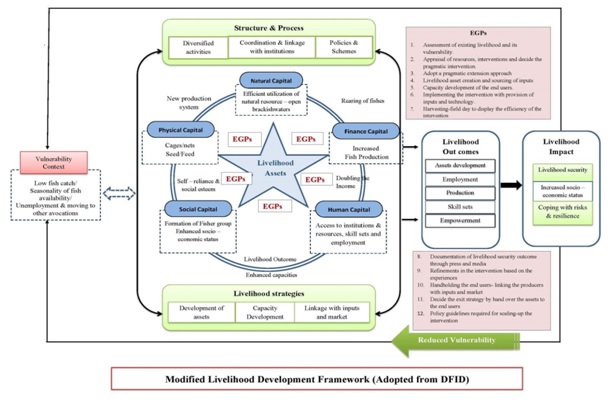
Twelve Extension Good Practices (EGPs), the ‘Standard Operating Practices’ to be adopted in planning and implementing of aquaculture based livelihood development programmes were evolved and evaluated with the ongoing livelihood development programmes. The sustainable livelihood framework proposed by the Department of International Development (DFID) was modified suitably and Extension Good Practices (EGPs) were incorporated. These EGPs would facilitate the asset creation and strategies to be adopted in the development of aquaculture based sustainable livelihoods. This framework was adopted to evaluate the aquaculture based production systems for the livelihood security of coastal farm families and the results indicated that the production systems have provided the livelihood security to the coastal farm families.
- Knowledge Management and economic empowerment of aqua farmers
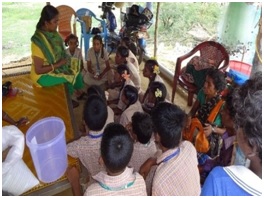
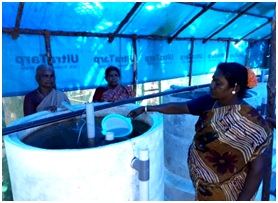
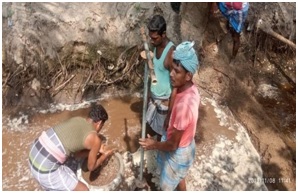
Brackishwater Aquaculture based farming system activities are being implemented in three villages in Tiruvallur districts and two villages in Nagappatinam district of Tamil Nadu for improving the livelihood security of resource poor aqua farmers. In Tiruvallur district, brackishwater aquaculture technologies like milk fish farming, seabass nursery rearing (in hapas) in open waters and pond, seabass farming (in FRP cages) in open waters and pond, crab farming (in pond), Penaeus indicus farming (in pond), Etroplus suratensis (Pearlspot) farming are being integrated with poultry, mushroom farming, kitchen gardening and community / societal development like distribution of diesel engine, solar lights and farm implements. On an average the aqua farmers group consisting of 10 members could earn Rs.6000/member for a period of eight months. In Nagappatinam district similar aqua farmers implementing similar interventions could earn about Rs.5800/member for a period six months.
5. Waste to Wealth in fisheries and aquaculture
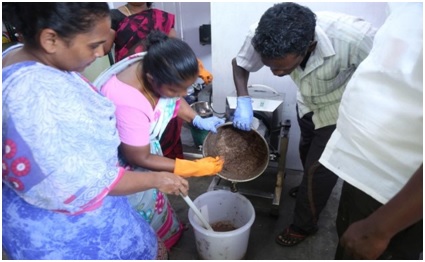
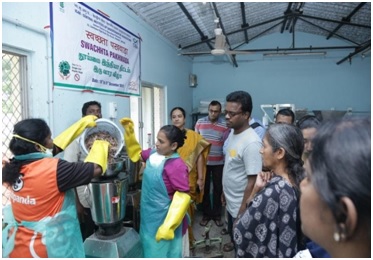
PlanktonPlus developed by CIBA has proven its efficiency in various aquaculture systems for different species. This technology has been transferred to ‘Nambikkai Fish Farmers Group’, Nambikkai Nagar, Chennai, through start-up India programme. CIBA provides the necessary hand-holding and training to the Nambikkai Fish Farmers Group on production and marketing of PlanktonPlus and HortiPlus. The group is producing PlanktonPlus and HortiPlus using Fish-waste sourced from locals, and processed at the Start-up Unit established by CIBA. Impact of this initiative, the group has produce 10314 Kg of Plantonplus and 1350 Hortiplus and received Rs. 678500/-. The group is processing the fish waste persistently and producing Plantonplus and Hortiplus as an alternative livelihoods activity. This initiative is not only cleaning and hygienic disposal of fish market waste which is abundantly available in the village cluster but also will help to produce wealth from waste as a concept of circular economy.
HIGHLIGHTS
- Aquastat 2019 – a Database on aqua-food production, export and trade data are compiled and published as a document for the use of stakeholders.
- Methodologies for impact assessment and evaluation aquaculture technologies and projects
- CIBA Shrimpapp for technology communication and capacity enhancement of stakeholders
- Video film on institute activities and capsule films on different aqua culture technologies.